
Visa issuance is a critical process that connects the United States to the rest of the world, facilitating global mobility for students, skilled workers, tourists, and families seeking to reunite. Under normal circumstances, the U.S. immigration system operates with a predictable rhythm, governed by established laws and international agreements. However, the reality of international relations means that this process is deeply intertwined with global events. When political conflicts erupt, the ripple effects are felt far beyond the borders of the affected nations. For a U.S. audience—including prospective immigrants, international students, multinational employers, and families waiting to reunite—understanding how geopolitical instability impacts immigration is essential.
Wars, diplomatic disputes, and regional instability do not just dominate the headlines; they directly disrupt the bureaucratic machinery that governs global travel. From sudden embassy closures to heightened security screenings, political conflicts can lead to severe visa processing delays and widespread travel disruptions. In this comprehensive guide, we will explore how international crises alter immigration policy, disrupt consular services, and create significant U.S. visa delays. Whether you are an employer relying on foreign talent or a family waiting for an immigrant visa, understanding these dynamics is the first step toward navigating an unpredictable landscape.
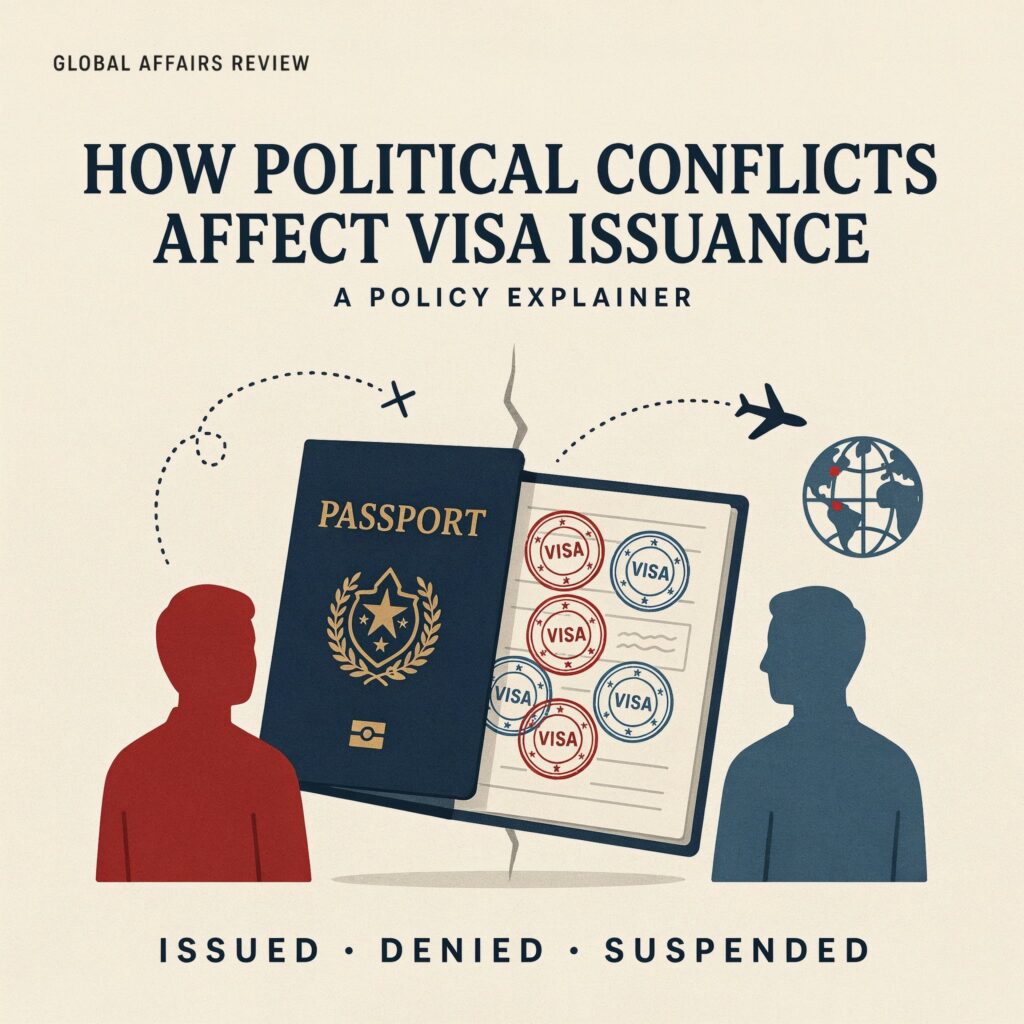
What Political Conflicts Mean for Visa Processing
At its core, visa issuance relies on stable diplomatic relations and functional international infrastructure. When political conflicts arise, the foundation of this system is shaken. Geopolitical tensions—ranging from trade wars and diplomatic spats to full-scale armed conflicts—force governments to reassess their security postures and foreign policy objectives. In the United States, immigration policy is not created in a vacuum; it is highly responsive to the global security environment.
When a country experiences regional instability or becomes embroiled in a conflict, the U.S. government must evaluate the potential risks associated with issuing travel documents to nationals from that region. Wars and violent conflicts often lead to a breakdown in the ability to verify applicant backgrounds. If a foreign government’s civil registry is compromised, or if local law enforcement databases are inaccessible due to conflict, U.S. consular officers lose crucial tools needed to conduct thorough background checks.
Furthermore, political conflicts frequently result in the imposition of international sanctions or targeted travel bans. These measures are designed to exert pressure on adversarial regimes, but they inevitably create collateral damage for ordinary citizens. Sanctions can complicate the payment of visa fees or the transfer of financial documents required to prove sponsorship. Diplomatic breakdowns can lead to the expulsion of diplomats, the severing of official communication channels, and the suspension of bilateral agreements that facilitate smoother visa issuance. Ultimately, what starts as a geopolitical dispute quickly translates into administrative hurdles, changing the rules of engagement for anyone seeking to enter the United States.
How Conflicts Disrupt Consular Operations
The most immediate and visible impact of political conflicts on visa issuance is the disruption of consulate operations. Embassies and consulates are physical outposts of the U.S. government, and the safety of their personnel is paramount. When violence escalates or regional instability threatens the security of diplomatic staff, the U.S. State Department is often forced to order the evacuation of personnel or implement sudden embassy closures.
When an embassy closes or significantly reduces its footprint, consular services grind to a halt. This leads to immediate visa appointment cancellations, leaving thousands of applicants in limbo. For those who have spent months or even years preparing their applications, paying fees, and gathering documentation, a sudden cancellation is devastating. In many cases, applicants are forced to seek services at U.S. embassies in third countries, which introduces immense logistical and financial burdens. Traveling to a neighboring country for a visa interview is not only expensive but also risky, especially if the applicant is fleeing a conflict zone or if neighboring borders are tightly controlled.
Even when embassies remain open, reduced staffing severely limits their capacity. Consular officers may be reassigned to handle emergency services for U.S. citizens abroad, such as evacuations or emergency passport replacements, leaving fewer officers available to process routine nonimmigrant and immigrant visas. Furthermore, local staff, who are essential for the day-to-day functioning of the consulate, may be unable to commute safely due to violence or infrastructure collapse. This combination of factors dramatically slows down processing and creates immediate bottlenecks in the system.
Effects on Different Visa Types
Political conflicts do not discriminate based on the type of visa an individual holds or is applying for. Both immigrant visas and nonimmigrant visas are profoundly impacted, albeit in different ways.
Immigrant Visas
For those seeking to permanently relocate to the United States, an immigrant visa represents a life-changing opportunity. Family-sponsored visas and employment-based green cards require extensive processing, often taking years under the best circumstances. When political conflicts disrupt consular operations, these already lengthy timelines are extended exponentially.
Because immigrant visas are subject to strict annual numerical caps, missing a processing window due to embassy closures can result in a visa number expiring or rolling over, forcing the applicant to wait for the next fiscal year. Moreover, medical examinations required for immigrant visas must be conducted by approved panel physicians. In conflict zones, medical infrastructure is often destroyed, making it impossible for applicants to complete this mandatory step, thereby stalling their visa issuance indefinitely.
Nonimmigrant Visas
Nonimmigrant visas, which cover temporary stays, are equally vulnerable to geopolitical tensions.
- Student Visas (F-1/M-1): International students from conflict-affected regions often face critical deadlines for university enrollment. If consulate operations are suspended, students may miss the start of their academic semesters, leading to deferred admissions or the loss of hard-won scholarships.
- Work Visas (H-1B, L-1, O-1): U.S. employers rely on foreign talent to fill specialized roles. When visa interviews are canceled or delayed, companies face severe labor shortages and project delays. The inability of a key engineer or executive to enter the U.S. can have cascading effects on business operations and innovation.
- Tourist and Business Visas (B-1/B-2): For tourists and business travelers, visa processing delays can mean missed conferences, canceled family visits, and lost economic opportunities. Furthermore, individuals from conflict zones often face heightened scrutiny when applying for tourist visas, as consular officers must ensure the applicant has strong ties to their home country and does not intend to overstay their visa due to the instability back home.
Why Delays Happen
The mechanics behind U.S. visa delays during times of political conflict are complex and multi-layered. It is not simply a matter of closed doors; the very nature of the vetting process changes in response to global events.
Security Concerns and Administrative Processing
The primary driver of delays during geopolitical tensions is the escalation of security concerns. When a region is unstable, the U.S. government increases its vigilance to prevent individuals with ties to extremist groups or hostile state actors from entering the country. This often results in a surge of cases being placed into administrative processing (often referred to as a Section 221(g) refusal).
Administrative processing involves extensive background checks, inter-agency consultations, and requests for additional documentation. While standard background checks might take a few weeks, administrative processing triggered by regional instability can take months or even years to resolve. Consular officers cannot issue a visa until these security clearances are fully adjudicated, and applicants have little recourse but to wait.
Travel Restrictions and Visa Suspensions
In extreme cases, political conflicts lead to formal travel restrictions or a complete visa suspension for nationals of specific countries. These policy shifts are often enacted via Presidential Proclamations and can halt the issuance of both immigrant and nonimmigrant visas overnight. Even if a formal ban is not in place, the U.S. State Department may issue travel advisories warning U.S. citizens against traveling to the region, which inherently slows down the reciprocal flow of travelers and visa applicants.
Visa Backlogs and Resource Allocation
When an embassy reopens after a period of closure or instability, it faces a massive backlog of postponed cases. Consular sections must triage these applications, often prioritizing emergency cases, diplomatic travel, or cases that have been pending the longest. This triage process means that new applicants face significantly longer visa wait times. Additionally, the reallocation of federal resources to manage the crisis—such as processing refugee claims or handling humanitarian parole requests—draws personnel away from standard visa adjudication, compounding the visa backlogs.
Who Is Most Affected
The human cost of these bureaucratic disruptions is immense, affecting a wide cross-section of society in the United States and abroad.
Families
Perhaps the most heartbreaking impact is felt by families separated by borders. U.S. citizens and lawful permanent residents waiting for spouses, children, or parents to join them often endure agonizing waits. When embassy closures occur in the applicant’s home country, families are forced to navigate complex legal and logistical hurdles to attend visa interviews in third countries. The emotional toll of prolonged separation, exacerbated by the danger their loved ones face in a conflict zone, cannot be overstated.
Students and Universities
U.S. universities pride themselves on their diverse, international student bodies. However, political conflicts threaten this diversity. Students from affected regions may be unable to secure their visas in time for the fall semester. This not only disrupts the student’s educational trajectory but also impacts university revenue and campus diversity. Universities often have to scramble to provide remote learning options or defer enrollments, creating administrative chaos and depriving U.S. campuses of global perspectives.
Employers and the Economy
In a highly competitive global economy, U.S. companies rely on specific visa programs to secure top-tier talent. When visa processing delays occur due to geopolitical tensions, employers are left with critical vacancies. Tech companies, research institutions, and healthcare providers may find themselves unable to bring in specialized experts, stifling innovation and economic growth. Small businesses that rely on seasonal or temporary foreign workers also suffer, potentially leading to reduced services or increased costs for consumers.
Travelers and Humanitarian Workers
Journalists, aid workers, and diplomats operating in conflict zones rely on swift visa issuance to move in and out of danger. Delays in processing their nonimmigrant visas can hinder critical humanitarian missions and limit the free flow of information from war-torn regions, impacting global awareness and relief efforts.
How Applicants Can Respond
Navigating the immigration system during a period of political conflict requires patience, flexibility, and proactive planning. While applicants cannot control geopolitical tensions, they can take specific steps to mitigate the impact of U.S. visa delays.
Monitor Official Updates
The most crucial step is to stay informed through official channels. Applicants should regularly check the website of the specific U.S. embassy or consulate handling their case, as well as the U.S. State Department’s travel advisory page. Consulates frequently post updates regarding embassy closures, reduced consular services, and changes to visa appointment availability. Subscribing to email alerts or following official embassy social media accounts can provide real-time information.
Prepare Documents Early and Thoroughly
Because administrative processing and security concerns are heightened during conflicts, the margin for error in an application is virtually zero. Applicants must ensure that all documentation is complete, accurate, and meticulously organized. Any missing document or discrepancy can trigger a Request for Evidence (RFE) or a 221(g) administrative processing hold, adding months to an already delayed timeline. Gathering civil documents, police certificates, and financial records well in advance is essential, especially since obtaining these documents may become impossible if the home country’s infrastructure collapses.
Explore Third-Country Processing
If the U.S. embassy in the applicant’s home country is closed or experiencing severe visa backlogs, applicants may need to consider applying at a U.S. consulate in a third country. However, this option requires careful research. Not all embassies accept third-country nationals, and securing a visa interview in a neighboring country may require obtaining a transit or visitor visa for that country first. Applicants must weigh the logistical costs and safety risks against the potential time saved.
Seek Expedited Appointments
In cases involving genuine emergencies—such as a life-threatening medical condition, a death in the family, or an urgent need to resume studies or employment in the U.S.—applicants can request an expedited visa interview. While these requests are granted sparingly, providing compelling, documented evidence of the emergency can sometimes bypass standard visa wait times.
Consult with Employers or Universities
Applicants should maintain open lines of communication with their U.S. sponsors. Employers and university international student offices often have dedicated legal counsel or immigration advisors who can provide guidance, issue updated support letters, or advocate on the applicant’s behalf. In some cases, employers may explore alternative visa categories or legal pathways to bring essential workers to the United States.
Long-Term Consequences
The intersection of political conflicts and visa issuance has profound long-term consequences that extend far beyond individual applicants.
Economically, chronic visa processing delays can alter global migration patterns. If the United States is perceived as unreliable or excessively difficult to enter due to frequent policy shifts and administrative bottlenecks, highly skilled workers and international students may choose to take their talents and tuition dollars to competing nations like Canada, Australia, or the United Kingdom. This “brain drain” away from the U.S. can weaken American competitiveness in critical sectors like technology, engineering, and scientific research.
Socially, prolonged visa backlogs contribute to a growing population of mixed-status families living in a state of perpetual uncertainty. The psychological stress of navigating an unpredictable immigration system, compounded by the trauma of regional instability, takes a heavy toll on mental health and community cohesion.
Furthermore, the disruption of consular services hampers the U.S. government’s ability to project soft power. Visa issuance is a primary tool of cultural and educational exchange. When students, artists, and business leaders are unable to visit the United States, the mutual understanding that underpins strong diplomatic relations erodes. In this way, the administrative fallout of political conflicts can inadvertently deepen the very geopolitical divides it seeks to manage.
Conclusion
The process of visa issuance is a complex mechanism that is highly sensitive to the shifting winds of global politics. As we have seen, political conflicts, regional instability, and diplomatic disputes can trigger embassy closures, massive visa backlogs, and grueling administrative processing delays. For immigrants, students, employers, and families across the United States, these disruptions are not abstract geopolitical concepts—they are life-altering obstacles that cause significant travel disruptions and emotional distress.
While the U.S. government must prioritize national security and adapt its immigration policy to address emerging security concerns, the collateral impact on innocent applicants remains a significant challenge. Navigating this environment requires vigilance, thorough preparation, and an understanding of the broader forces at play. By staying informed through the U.S. State Department, preparing documentation meticulously, and maintaining flexibility, applicants can better weather the storms of international instability. Ultimately, recognizing the deep connection between global conflicts and U.S. visa delays is essential for anyone navigating the modern immigration landscape.
Disclaimer: Immigration policies and consular operations can change rapidly in response to global events. Always verify the most current information and requirements directly with the U.S. Department of State or a qualified immigration attorney.