
Navigating the U.S. immigration system can feel overwhelming, especially when your career goals depend on securing work authorization. For many international professionals and students, the H1B visa is the primary gateway to long-term employment in the United States. This comprehensive guide breaks down everything you need to know about the H-1B visa, including eligibility, employer sponsorship, the cap lottery, costs, and application timelines. Whether you are an F-1 student on OPT, a foreign professional, or a U.S. employer, understanding this process is the first step toward success.
Disclaimer: Immigration rules are subject to change. This article is for informational purposes only and does not constitute legal advice. Always confirm current details with USCIS or consult a licensed immigration attorney.
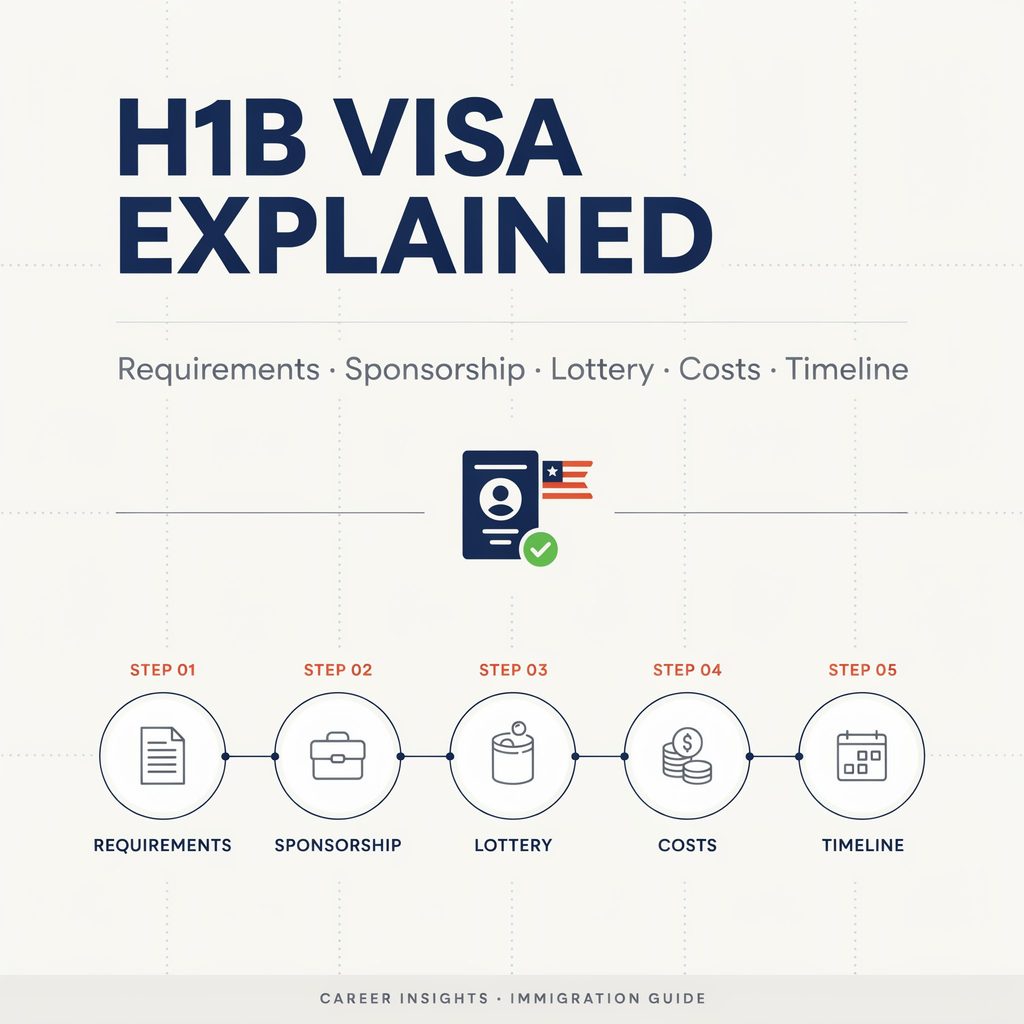
What Is an H1B Visa?
The H-1B is a nonimmigrant visa classification that allows U.S. employers to temporarily hire foreign workers in specialty occupations. A specialty occupation requires the theoretical and practical application of a body of highly specialized knowledge. The H1B visa is highly sought after because it is a “dual intent” visa. Unlike many other temporary work visas, the H-1B allows you to legally pursue permanent residency (a green card) while maintaining your temporary nonimmigrant status. Initially granted for up to three years, the H-1B status can generally be extended to a maximum of six years, with further extensions possible under certain circumstances.
Who Qualifies for an H1B Visa?
The H1B visa is designed for skilled professionals. Typical candidates include international professionals recruited directly from abroad, international students currently studying in the U.S. on F-1 visas, and individuals transitioning from other temporary visa categories. To qualify, the prospective employee must possess the required educational background or equivalent work experience, and the U.S. employer must have a legitimate need for a specialty occupation worker. The relationship must be a traditional employer-employee dynamic, meaning the sponsoring company must have the right to control the worker’s employment, including when, where, and how the work is performed.
H1B Visa Requirements for Workers
To be eligible as a beneficiary for an H-1B petition, you must meet specific educational and professional criteria. The primary requirement is holding a U.S. bachelor’s degree or higher in a directly related field. If you earned your degree outside the United States, you must undergo a foreign credential evaluation to prove your education is equivalent to a U.S. bachelor’s degree.
In some cases, progressive work experience can substitute for formal education. Generally, three years of specialized work experience may equate to one year of college. However, this “experience equivalency” must be thoroughly documented and evaluated by a recognized credentialing service. Additionally, if your profession requires a state license, certification, or registration to practice in the U.S. (such as nursing or engineering), you must possess the appropriate unrestricted authorization before your H1B petition can be approved.
H1B Specialty Occupation Explained
The cornerstone of the H-1B classification is the “specialty occupation” requirement. According to the Department of Labor (DOL) and USCIS, a specialty occupation must meet at least one of the following criteria:
- A bachelor’s degree or higher (or its equivalent) is normally the minimum entry requirement for the position.
- The degree requirement is common to the industry in parallel positions among similar organizations.
- The employer normally requires a degree or its equivalent for the position.
- The nature of the specific duties is so specialized and complex that the knowledge required to perform the role is usually associated with the attainment of a bachelor’s or higher degree.
Common H1B specialty occupations include software developers, financial analysts, accountants, architects, engineers, and medical professionals. However, simply having a degree is not enough; the job duties themselves must be complex enough to necessitate that specific degree.
Employer Sponsorship Requirements
You cannot apply for an H-1B visa on your own; you must have a sponsoring U.S. employer. Employer sponsorship involves several strict legal and financial responsibilities. Before filing a petition with USCIS, the employer must submit a Labor Condition Application (LCA) to the Department of Labor.
The LCA ensures that hiring a foreign worker will not adversely affect the wages and working conditions of similarly employed U.S. workers. The employer must attest to paying the higher of the “prevailing wage” for the occupation in the geographic area of employment or the actual wage paid to other employees with similar qualifications. Furthermore, the employer must provide working conditions that do not negatively impact U.S. workers and attest that there is no strike or lockout at the place of employment.
H1B Visa Application Process: Step by Step
The H1B visa application process is employer-driven. Here is the standard step-by-step workflow for a cap-subject petition:
- H-1B Registration Period: In March, the employer submits an electronic registration for the prospective employee through the USCIS online portal. This requires basic company and beneficiary information and a nominal registration fee.
- Lottery Selection: USCIS conducts a random selection process if registrations exceed the annual cap. Only selected registrants are eligible to file a full petition.
- Prevailing Wage Determination (Optional but Recommended): Employers often file a Prevailing Wage Determination (PWD) request with the DOL to confirm the minimum wage they must pay.
- Labor Condition Application (LCA): The employer files the LCA with the DOL. The DOL typically certifies the LCA within seven days.
- Form I-129 Petition: Once the LCA is certified, the employer compiles the H-1B petition (Form I-129) along with the certified LCA, supporting evidence, and filing fees, and submits it to USCIS.
- USCIS Adjudication: USCIS reviews the petition. They may approve it, deny it, or issue a Request for Evidence (RFE) if more information is needed.
- Visa Stamping or Change of Status: If approved and the beneficiary is outside the U.S., they apply for an H-1B visa stamp at a U.S. consulate (consular processing) by completing Form DS-160. If the beneficiary is already in the U.S. (e.g., on F-1 OPT), the employer can request a change of status to begin working on October 1.
H1B Registration and Lottery Process
Because demand for the H1B visa historically far exceeds supply, USCIS implemented an electronic registration system to manage the H-1B lottery. During the initial registration period (usually in March), employers create an online account and enter their prospective workers into the system.
If the number of registrations exceeds the statutory cap, USCIS conducts a random lottery. Recently, USCIS implemented a beneficiary-centric selection process to prevent fraud, meaning individuals are entered into the lottery only once, regardless of how many job offers they have. Furthermore, USCIS has moved toward a weighted selection approach tied to the wage level of the offered position, prioritizing higher-paying roles to ensure the program attracts top-tier talent. If your registration is selected, your employer receives a notification and has a designated window (typically starting April 1) to file the complete cap-subject petition.
H1B Cap: Regular Cap and Advanced Degree Exemption
Congress mandates an annual numerical limit, known as the H-1B cap, on the number of new H-1B visas issued each fiscal year.
- Regular Cap: There are 65,000 slots available for foreign workers holding at least a bachelor’s degree.
- Advanced Degree Exemption (Master’s Cap): An additional 20,000 slots are reserved exclusively for beneficiaries who have earned a master’s degree or higher from a qualifying U.S. institution.
USCIS first runs the lottery for the 65,000 regular cap. Any advanced-degree registrations not selected in the first round are then pooled into a second lottery for the 20,000 master’s cap. This two-tiered system statistically increases the selection odds for those holding U.S. graduate degrees.
Cap-Subject vs. Cap-Exempt H1B Petitions
Not all H1B visas count against the annual 85,000 numerical limit. Petitions are broadly categorized into two types: cap-subject and cap-exempt.
- Cap-Subject Petitions: These are filed by private, for-profit employers. They must go through the March registration process, the lottery, and can only be filed if selected. Employment generally cannot begin until October 1, the start of the federal fiscal year.
- Cap-Exempt Petitions: Certain organizations are exempt from the numerical cap and the lottery. These include institutions of higher education, non-profit entities affiliated with or related to higher education, non-profit research organizations, and governmental research organizations. If you are hired by a cap-exempt employer, they can file an H-1B petition on your behalf at any time during the year, and you can begin working as soon as the petition is approved.
H1B Visa Costs and Fees
The financial burden of the H-1B process falls primarily on the sponsoring employer. By law, employers cannot require the employee to pay certain mandatory filing fees, as doing so would illegally drop the worker’s wage below the required prevailing wage.
Below is an overview of the standard cost categories associated with an H-1B petition. (Note: Exact USCIS fees and legal costs are subject to change; always check the latest USCIS guidance or consult your attorney.)
| Cost Category | Who Typically Pays? | Description |
|---|---|---|
| Registration Fee | Employer | A nominal fee to enter the electronic H-1B lottery system. |
| Base Filing Fee (Form I-129) | Employer | The standard processing fee for the H-1B petition. |
| ACWIA Fee | Employer | Funds U.S. worker training. Amount varies based on company size (e.g., under/over 25 employees). |
| Fraud Prevention and Detection Fee | Employer | A mandatory fee used to combat H-1B fraud. |
| Public Law 114-113 Fee | Employer | An additional fee for companies with 50+ employees where >50% are on H-1B or L-1 visas. |
| Asylum Program Fee | Employer | A recently introduced fee to support asylum processing, varying by employer size. |
| Premium Processing (Optional) | Employer or Employee | An optional fee (Form I-907) for a guaranteed 15-day adjudication timeline. |
| Immigration Attorney Fees | Employer | Professional legal fees for preparing the LCA and Form I-129 petition. |
H1B Visa Timeline: How Long Does It Take?
The H-1B timeline is highly structured for cap-subject petitions. The registration period opens in March. The lottery is conducted shortly after, and employers are notified of selected candidates by late March or early April.
Employers then have a 90-day window to prepare and submit their H-1B petitions. Standard USCIS processing can take anywhere from a few months to over a year. However, employers can pay for Premium Processing to guarantee a response (approval, denial, or RFE) within 15 calendar days. If approved with a change of status, the employee’s H-1B status officially activates on October 1 of the same year.
Documents Required for an H1B Petition
A successful H-1B petition requires a robust documentary record to prove both the employer’s legitimacy and the worker’s qualifications. Key documents include:
- Beneficiary Documents: Valid passport, U.S. degree certificates and official transcripts (or foreign equivalent with credential evaluation), updated resume/CV, and recent pay stubs (if currently working in the U.S.).
- Employer Documents: Federal Employer Identification Number (FEIN), detailed company profile, financial statements, and the signed offer letter detailing the job title, duties, salary, and employment dates.
- Job Specifics: A comprehensive support letter explaining why the role qualifies as an H1B specialty occupation, how the employee’s degree directly relates to the job duties, and organizational charts demonstrating the employer-employee relationship.
If filing for a change of status from F-1 OPT, the employer must also include copies of the student’s I-20 forms and EAD card.
Common H1B RFE Reasons and How to Avoid Them
A Request for Evidence (RFE) is issued when a USCIS adjudicator needs more information to approve a petition. Receiving an RFE is common and does not mean the petition will be denied, but it will delay processing. Common RFE triggers include:
- Specialty Occupation Doubts: USCIS may question whether the job duties are truly complex enough to require a specific bachelor’s degree. Avoid this by providing highly detailed job descriptions and industry standards.
- Employer-Employee Relationship: If the worker will be placed at a third-party client site, USCIS may question whether the sponsoring employer maintains the right to control the worker’s employment. Detailed contracts and itineraries are vital here.
- Degree Equivalency: If the worker’s degree is from a foreign country or in a field slightly different from the job offer, USCIS may demand an expert evaluation letter to bridge the gap.
- Availability of Work: USCIS must be convinced there is sufficient, non-speculative work available for the entire requested H-1B period.
H1B Transfer, Extension, and Change of Employer
The H-1B visa is tied to your sponsoring employer, but the immigration system allows for “portability.” If you wish to change jobs, your new employer must file an H-1B transfer petition. Under the American Competitiveness in the Twenty-First Century Act (AC21), you can generally begin working for the new employer as soon as USCIS receives the transfer petition, without waiting for final approval.
The standard maximum duration for H-1B status is six years. However, if you have an approved I-140 immigrant petition but are waiting for a green card priority date to become current, or if your PERM labor certification has been pending for over a year, you may be eligible for one-year or three-year H-1B extensions beyond the six-year limit.
H1B to Green Card: What Happens Next?
Because the H-1B is a dual intent visa, it serves as a popular stepping stone to permanent residency. The transition from H-1B to an employment-based green card typically involves three main stages:
- PERM Labor Certification: The employer tests the U.S. labor market to prove no qualified, willing U.S. workers are available for the position.
- Form I-140 (Immigrant Petition): Once the PERM is certified, the employer files the I-140 to establish the worker’s eligibility for a specific employment-based preference category (EB-1, EB-2, or EB-3).
- Form I-485 (Adjustment of Status): When the worker’s priority date becomes current according to the Visa Bulletin, they can file to adjust their status to permanent resident.
This process can take several years, making the six-year H-1B window a critical planning factor.
H4 Visa and H4 EAD for Dependents
The H-1B visa allows you to bring your immediate family members to the United States. Your legal spouse and unmarried children under the age of 21 can apply for H-4 dependent visas.
Historically, H-4 visa holders were not authorized to work. However, under current rules, certain H-4 dependent spouses are eligible to apply for an Employment Authorization Document (EAD). To qualify for an H-4 EAD, the primary H-1B holder must either be the beneficiary of an approved Form I-140 immigrant petition or have been granted H-1B extensions beyond the six-year limit under AC21. The H-4 EAD provides tremendous flexibility, allowing spouses to work for any employer, start a business, or pursue educational goals in the U.S.
Alternatives to the H1B Visa
The H-1B lottery is highly competitive, and many workers and employers must explore alternative visa options. Depending on your nationality, qualifications, and corporate structure, other classifications might be more suitable.
| Visa Type | Best For | Key Characteristics |
|---|---|---|
| L-1 Intracompany Transferee | Multinational executives or specialized knowledge workers | Requires the employee to have worked for a foreign branch of the company for at least one year in the past three years. No annual cap. |
| O-1 Extraordinary Ability | Individuals at the top of their field (arts, sciences, business, athletics) | Requires extensive documentation of sustained national or international acclaim. No cap, can be filed anytime. |
| TN (NAFTA/USMCA) | Citizens of Canada and Mexico | Limited to a specific list of professions (e.g., engineers, scientists). Requires a bachelor’s degree or specific credentials. |
| E-2 Treaty Investor | Nationals of treaty countries who invest substantial capital in a U.S. business | Allows the investor and essential employees to work in the U.S. enterprise. |
| F-1 OPT / STEM OPT | International students graduating from U.S. institutions | Provides up to 12 months of work authorization, extendable by 24 months for qualifying STEM degrees. |
| Employment-Based Green Card | Permanent residency without a temporary visa step | Direct PERM filing is possible but rare and risky due to immigrant intent issues on non-dual intent visas. |
Frequently Asked Questions
1. Can I apply for an H1B visa without a job offer?
No. The H-1B is an employer-sponsored visa. You must have a legitimate job offer from a U.S. employer willing to file a petition on your behalf before you can apply.
2. What happens if I am not selected in the H-1B lottery?
If your registration is not selected, your employer cannot file a cap-subject petition for that fiscal year. Many F-1 students on OPT utilize their remaining OPT time, apply for a STEM OPT extension if eligible, or explore alternative visas like the O-1 or cap-exempt employment.
3. Can my employer require me to pay the H-1B filing fees?
No. Department of Labor regulations strictly prohibit employers from passing the mandatory H-1B filing fees (such as the ACWIA and Fraud Prevention fees) onto the employee, as this is viewed as an unlawful deduction from your prevailing wage.
4. Can I travel outside the U.S. while my H-1B petition is pending?
Traveling while a Change of Status petition is pending will generally result in the abandonment of that specific request. If you must travel, you will likely need to undergo consular processing at a U.S. embassy or consulate abroad to obtain your H-1B visa stamp before re-entering. Always consult your immigration attorney before traveling.
5. Does the H-1B visa lead to a green card?
Yes. The H-1B is a dual intent visa, meaning you can legally pursue permanent residency (a green card) while maintaining your temporary H-1B status. Your employer can initiate the green card process (PERM and I-140) at any time during your H-1B tenure.
6. What is the “60-day grace period” for H-1B workers?
If your employment is terminated (whether you resign or are laid off), USCIS provides a one-time grace period of up to 60 consecutive days, or until the end of your authorized validity period, whichever is shorter. During this time, you can seek a new employer to file an H-1B transfer, change to another visa status, or prepare to depart the United States.
Conclusion
The H1B visa remains a vital pathway for global talent to contribute to the U.S. economy, offering a bridge from temporary employment to permanent residency. While the registration lottery, prevailing wage requirements, and extensive documentation can seem daunting, understanding the step-by-step process empowers both professionals and employers to navigate the system confidently. Because immigration policies frequently evolve, it is crucial to stay informed. Assess your eligibility carefully, review the latest USCIS guidance, and always seek qualified legal guidance from a licensed immigration attorney to protect your career journey.