
You’ve just spotted a round-trip fare to Lisbon for under $500. Or maybe your cousin’s wedding in Jaipur is eight weeks away, your graduate program in Seoul starts in September, or your company has scheduled a conference in São Paulo. The excitement is real—but there’s one problem. You haven’t received your visa yet, and you have no idea when the decision will arrive.
If this scenario feels familiar, you are not alone. Millions of U.S.-based travelers, international students, visiting family members, and business professionals face the same tension every year: the desire to lock in great travel deals versus the uncertainty of a pending visa application.
Here is the core principle that will protect your wallet and your peace of mind: Do not commit to nonrefundable travel arrangements until your visa is approved—unless you fully understand and can afford the financial risk. Visa processing timelines vary substantially by destination country, visa category, applicant circumstances, consulate workload, security checks, document completeness, and seasonal demand. Published estimates are guidelines, not guarantees.
This guide walks you through how to build a realistic international travel plan around a visa approval timeline, minimize financial exposure, and still enjoy the trip you’ve been dreaming about.
Why Visa Approval Timelines Matter for International Travel Planning
Every country sets its own rules for who needs a travel visa, what documents to submit, and how long processing takes. A tourist visa application for one destination might be approved in five business days; a visitor visa for another could take three months or longer. Consulate processing time fluctuates with staffing levels, geopolitical events, and the volume of applications received.
When you’re managing travel plans pending visa approval, the clock is not entirely in your hands. Understanding the visa processing time landscape helps you set expectations, protect your budget, and avoid last-minute visa issues that can derail months of preparation.
Breaking Down the Visa Timeline: Four Distinct Phases
Many travelers conflate several separate stages into one vague “waiting period.” Separating them helps you plan more accurately.
Visa Appointment Wait Time
This is the gap between the day you request an embassy visa appointment and the day you actually attend. During peak seasons, visa appointment wait time at popular consulates can stretch from a few days to several weeks. Always check the official embassy website for current availability.
Application Processing Time
Once you submit your visa application documents and attend your interview (if required), the consulate begins its review. This visitor visa processing phase includes background checks, document verification, and sometimes inter-agency security screening. Consulate processing time can range from a few days to several months.
Passport Return Time
After a decision is made, your passport must be physically returned to you—either by courier or in-person pickup at a visa application center. Passport return time typically adds two to seven business days, but courier delays or public holidays can extend this.
Total End-to-End Visa Timeline
The visa approval timeline, measured from the moment you begin gathering documents to the moment your passport is back in hand with the visa stamp or sticker, is the number you should plan around. Build your international trip checklist using this full span, not just the processing estimate.
How to Estimate a Realistic Visa Timeline
Start by visiting the official embassy website or the relevant visa application center portal for your destination. Look for:
- Current visa appointment wait time for your visa category.
- Published processing estimates (treat these as minimums, not maximums).
- Any advisories about visa application delays or backlogs.
- Seasonal notices about increased demand.
Next, add a personal buffer. If the consulate lists 15 business days, mentally plan for 20 to 25. If you need to mail documents or travel to a distant consulate, add transit days. Check your visa application status periodically through official channels, but avoid making irreversible decisions based on an optimistic reading.
Why You Should Apply Early—Especially Before Peak Seasons
Embassy appointment availability tightens dramatically before summer vacations, winter holidays, spring break, major international events (World Cup, Olympics, large festivals), and school enrollment periods. Applying early is the single most effective way to reduce stress and protect your travel plans.
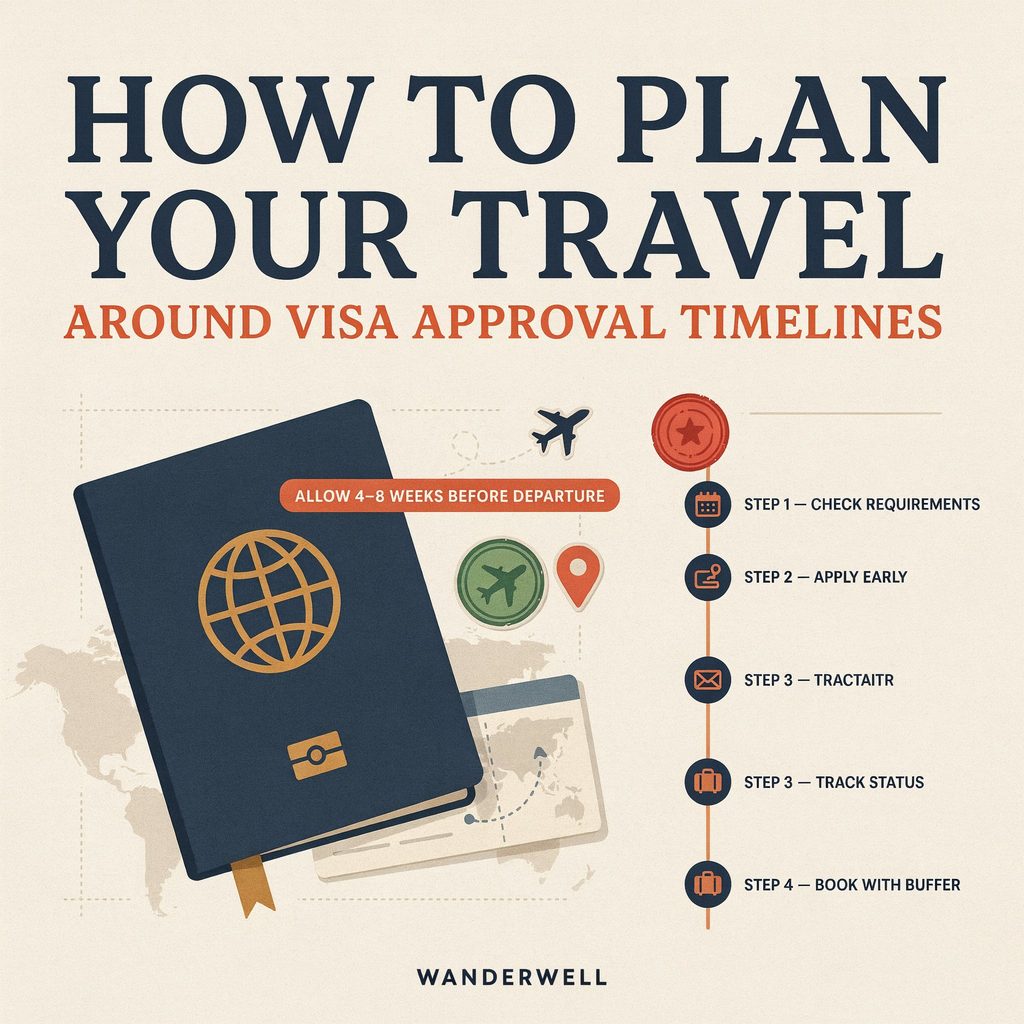
As a rule of thumb, begin researching travel visa requirements and gathering your visa application checklist three to six months before your intended departure date. This window accounts for document collection, appointment scheduling, processing, passport return, and a safety margin for visa processing delays.
Step-by-Step Travel-Planning Timeline
Three to Six Months Before Departure
- Confirm whether you need a visa and identify the correct visa category.
- Review the official embassy website for required visa application documents.
- Gather or renew your passport; verify passport validity for international travel (many countries require six months beyond your return date).
- Book your visa interview appointment at the earliest available slot.
- Research flights and accommodations but do not purchase nonrefundable options.
Six to Eight Weeks Before Departure
- Attend your visa interview appointment or submit your application at the visa application center.
- Hold a provisional travel itinerary for your visa application—use refundable or placeholder reservations.
- Book refundable hotel reservations and flexible flight bookings if you must secure dates.
- Purchase travel insurance for visa delays if available for your destination.
- Notify your employer, school, or event host of your timeline.
After the Visa Interview or Application Submission
- Track your visa application status through official channels only.
- Keep all reservations in a refundable or free-cancellation state.
- Avoid posting questions on social media forums for case-specific guidance; rely on official sources or qualified immigration counsel.
- Prepare for the possibility that processing may exceed the published estimate.
After Visa Approval
- Confirm the visa details (dates, entries, conditions) are correct.
- Finalize flights, hotels, rail passes, cruise cabins, or tour packages.
- Purchase comprehensive travel insurance.
- Share your confirmed itinerary with family, employers, or travel companions.
The Final Week Before Departure
- Reconfirm all bookings.
- Print or save digital copies of your visa, passport, itinerary, insurance policy, and hotel confirmations.
- Review your travel document checklist one last time.
- Arrange airport transport and check in online if possible.
Travel Planning Timeline Around Visa Approval
| Travel Stage | Recommended Actions | Booking Advice | Key Risk to Avoid |
|---|---|---|---|
| 3–6 months out | Research requirements, gather documents, book visa appointment | Do not book anything nonrefundable | Committing funds before eligibility is confirmed |
| 6–8 weeks out | Attend interview, submit application, build provisional itinerary | Use refundable flight tickets and free-cancellation hotels only | Assuming the published processing time is guaranteed |
| Post-submission | Track visa application status, keep plans flexible | Maintain changeable reservations; avoid flight change fees by choosing flexible fares | Cancelling refundable bookings prematurely |
| Post-approval | Verify visa details, finalize all arrangements | Lock in flights, hotels, tours, cruise cabins | Overlooking visa validity dates or entry conditions |
| Final week | Reconfirm bookings, organize documents, arrange transport | Print confirmations; save offline copies | Arriving at the airport without required documents |
Choosing Flexible Travel Arrangements
Flights
Opt for refundable flight tickets or flexible flight booking options, even if they cost slightly more. Understand the airline’s hotel cancellation policy equivalent—its change and cancellation terms—before purchase. Avoid nonrefundable airfare until the visa is physically in your passport.
Accommodations
Search for properties with a free-cancellation window that extends beyond your expected visa approval timeline. A refundable hotel reservation protects you if processing runs long or if visa denial travel plans force a cancellation.
Travel Insurance
Look for travel insurance for visa delays that covers trip cancellation or interruption due to a delayed or denied visa. Read the policy exclusions carefully; not every plan covers visa-related cancellations.
Rail and Cruise Reservations
Many European rail passes and cruise lines offer deposit-only booking or free cancellation up to 30–60 days before departure. Use these windows to hold space without full financial exposure.
Reserving Flights vs. Purchasing Tickets Before Visa Approval
Some consulates request proof of travel itinerary as part of the visa application. A flight reservation (a held booking with a confirmation code but no ticketed payment) can satisfy this requirement without spending hundreds of dollars on nonrefundable airfare. Travel agents and some airline websites can generate a temporary reservation valid for 7–14 days.
However, never present a fabricated itinerary. Use a legitimate, verifiable reservation. If the consulate requires a ticketed booking, purchase a fully refundable fare you can cancel after the decision.
Creating a Provisional Itinerary Without Misrepresenting Plans
Your travel itinerary for visa application should reflect a genuine, reasonable plan. Include intended dates, cities, and accommodation types, but note in your cover letter that final bookings will be confirmed upon visa issuance. This approach satisfies documentation requirements while keeping your options open if travel plans pending visa approval shift.
Coordinating Visa Timing with Time-Sensitive Events
- Destination weddings: Contact the host for a written invitation. Apply at least four months ahead. Keep your attendance flexible; discuss backup plans with the couple.
- Study abroad programs: Coordinate with your school’s international office. Many programs issue enrollment letters that support an urgent visa appointment request.
- Business meetings: Request an invitation letter from the host company. Ask whether the meeting can move to a virtual format if the visa is delayed.
- Medical travel: Obtain a letter from the treating physician. Some consulates prioritize medical cases, but expedited visa processing is never guaranteed.
- Cruises: Verify the cruise line’s cancellation policy. Book with a flexible deposit and travel insurance that covers visa delays.
- Family emergencies: Contact the relevant embassy directly; some offer emergency appointments, though approval and speed are not assured.
What If No Visa Appointment Is Available Before Your Departure Date?
- Check the embassy appointment availability page daily; cancellations open slots.
- See whether another consulate in the same country has earlier availability.
- Contact the visa application center to ask about waitlist options.
- If legitimate urgency exists, inquire about an urgent visa appointment through official channels.
- Adjust your travel dates if possible; communicate changes to hosts, employers, or schools.
What If Processing Takes Longer Than Expected?
Visa application delays happen. If your timeline slips:
- Check your visa application status on the official portal.
- Contact the embassy or consulate through their published inquiry channels—avoid third-party “fixers.”
- Extend refundable reservations rather than cancelling them.
- Notify your employer, school, tour operator, or event host early.
- Review your travel insurance for trip-delay coverage.
- Resist the urge to book alternative nonrefundable arrangements out of frustration.
Expedited Visa Processing: Benefits and Limits
Some countries offer expedited visa processing for documented emergencies, medical needs, or official travel. Eligibility criteria are strict, and approval is discretionary. An expedited request does not guarantee a faster decision, a favorable outcome, or an interview slot. Always submit expedite requests through the official embassy website and include supporting evidence.
Common Planning Mistakes to Avoid
- Booking nonrefundable airfare too soon. This is the costliest error travelers make.
- Submitting incomplete documents. Missing items trigger delays or denials.
- Relying on social-media advice instead of official sources. Processing times and rules change; only the embassy or consulate can confirm current requirements.
- Assuming an interview means approval. The interview is one step; the decision rests with immigration authorities.
- Waiting until the last minute. Travel planning buffer time is your best defense against surprises.
Managing Travel Costs and Reducing Financial Risk While You Wait
- Use fare-alert tools instead of purchasing tickets.
- Book accommodations with free cancellation up to 24–48 hours before check-in.
- Pay deposits rather than full balances for tours or cruises.
- Keep a separate “travel fund” so a delayed visa doesn’t strain essential finances.
- If the visa is denied, contact providers immediately to invoke cancellation protections.
Special Considerations for U.S. Residents Who Are Not U.S. Citizens
If you live in the United States on a work visa, student visa, green card, or pending adjustment-of-status application, returning to the United States after your trip is just as important as entering your destination country. Before you travel, verify:
- Your passport validity for international travel and any reentry documentation requirements.
- Whether your U.S. immigration status allows reentry and whether you need a valid visa stamp in your passport.
- If you are in a pending-status situation, whether advance parole or another travel authorization is required before departure.
- Any travel restrictions tied to your specific immigration category.
This area is highly individual. For case-specific immigration travel advice, consult the U.S. Citizenship and Immigration Services website (uscis.gov), the Department of State website (travel.state.gov), or a qualified immigration attorney. Do not rely on generalized internet guidance for your personal situation.
Example: Planning a Europe Trip While Waiting for a Visa
Maria, a lawful U.S. resident originally from Colombia, wants to spend two weeks touring Spain and Portugal in July. Here’s how she applies the principles in this guide:
- Four months out: Maria checks the official Spanish consulate website for her visa category, confirms she needs a Schengen short-stay visa, and reviews the visa application checklist. She books the earliest available visa interview appointment—six weeks away.
- Three months out: She researches flights but does not buy nonrefundable airfare. She identifies hotels with free cancellation through 48 hours before check-in and notes a backup travel window (shifting the trip by one week if needed).
- Two months out: Maria attends her embassy visa appointment, submits complete documents, and receives a tracking number. She books a refundable flight ticket and two refundable hotel reservations to satisfy the proof-of-travel-itinerary requirement.
- Waiting period: She monitors her visa application status weekly. She keeps all bookings flexible and avoids purchasing rail passes or tour deposits.
- After approval (five weeks later): Maria receives her passport with the Schengen visa. She confirms the validity dates, then converts her refundable flight to the preferred schedule, finalizes hotel bookings, buys a rail pass, and purchases comprehensive travel insurance.
- Final week: She prints all confirmations, checks passport validity, and heads to the airport with her international trip checklist complete.
By keeping every commitment reversible until the visa arrived, Maria protected roughly $3,200 in potential losses.
Final Practical Checklist
Before Booking Anything
- Confirm visa requirement and category on the official embassy website.
- Verify passport validity for international travel.
- Review the full visa application checklist.
Before Applying
- Schedule the earliest available visa interview appointment.
- Gather all visa application documents.
- Build a provisional travel itinerary with refundable options.
While Waiting for Approval
- Track visa application status through official channels.
- Keep all reservations flexible and refundable.
- Maintain a backup travel window.
- Communicate timeline updates to employers, schools, or hosts.
After Approval / Before Departure
- Verify visa details (dates, number of entries, conditions).
- Finalize flights, lodging, transport, and activities.
- Purchase travel insurance.
- Complete your travel document checklist.
- Confirm reentry requirements for returning to the United States.
Conclusion
Planning international travel around a visa approval timeline is entirely manageable when you start early, keep every reservation flexible, prepare complete documentation, and build generous buffer time into your schedule. The single safest strategy is to resist the temptation of nonrefundable deals until the visa is physically in your passport. Approval decisions rest solely with the destination country’s immigration authorities, so verify all requirements, fees, appointment availability, and processing guidance through the appropriate embassy, consulate, visa application center, or official government immigration website.
Start early. Stay flexible. Protect your budget. And once that visa stamp is in hand, go enjoy the trip you planned so carefully.
Frequently Asked Questions
1. Should I book flights before my visa is approved?
Avoid purchasing nonrefundable airfare before approval. If a consulate requires proof of travel, use a refundable flight ticket or a temporary flight reservation that you can cancel without penalty.
2. How long should I wait for visa approval before planning travel?
There is no universal answer. Check the destination’s published processing estimate, then add a buffer of one to three weeks. Begin the entire process three to six months before your intended departure.
3. Can I use a temporary flight reservation for a visa application?
Many consulates accept a held reservation or booking confirmation as proof of travel itinerary. Verify the specific requirement with the embassy before submitting. Never fabricate documents.
4. What happens if my visa is delayed after I book a trip?
Contact the embassy through official channels, extend any refundable reservations, and notify affected parties (employers, schools, hosts). Travel insurance for visa delays may reimburse certain costs if your policy covers that scenario.
5. Can I request expedited visa processing for an upcoming trip?
Some embassies offer expedited or urgent visa appointment options for documented emergencies. Eligibility is strict and approval is not guaranteed. Submit requests through official channels with supporting evidence.
6. How do I check my visa application status?
Use the tracking tool provided by the embassy, consulate, or visa application center where you submitted your application. Avoid third-party websites that claim to offer status updates.
7. Are refundable tickets worth it when a visa is pending?
In most cases, yes. The modest premium over a nonrefundable fare is far less than losing the entire ticket cost if the visa is delayed or denied.
8. What documents should I prepare before applying for a travel visa?
Common items include a valid passport, completed application form, passport-size photos, proof of financial means, travel itinerary, accommodation confirmations, travel insurance, and an invitation letter if applicable. Always check the specific visa application checklist on the official embassy website for your destination and visa category.