
What Is a Visa Medical Examination?
If you’re applying for a U.S. immigrant visa, a K-1 fiancé(e) visa, or adjusting your status inside the United States, a visa medical examination is a mandatory step between your paperwork and your interview. The U.S. government requires this screening to confirm you don’t carry a communicable disease of public health significance and that you meet vaccination requirements set by the CDC.
Think of it as a health checkpoint—not a judgment. Most applicants pass without issue. Still, walking in unprepared can delay your case by weeks or even months.
This guide walks you through exactly what to expect in a visa medical exam: who needs one, how to schedule it, what tests and vaccines you’ll encounter, what paperwork follows, and what to do if results require follow-up. Whether you’re a first-time applicant, a sponsor helping a family member, or an immigration attorney briefing a client, you’ll find actionable steps below.
Who Needs a Visa Medical Examination?
Not every visa applicant sits in a doctor’s office. Here’s the quick breakdown:
- Immigrant visas (IR/CR categories, family-sponsored, employment-based): Required. You’ll see a panel physician approved by the U.S. embassy or consulate in your home country.
- K-1 fiancé(e) and K-2 children: Required, same panel-physician process.
- Adjustment of Status (Form I-485) filed inside the U.S.: Required. You’ll visit a USCIS-designated civil surgeon who completes Form I-693 (Report of Immigration Medical Examination and Vaccinations).
- Certain nonimmigrant visas (some work visas, refugee/asylee processing): May be required depending on the consular post or USCIS instruction.
- F-1 student visas and B-1/B-2 tourist visas: Generally not required, though individual embassies can request one in rare cases.
Exceptions and age notes: Children under a certain age may be exempt from specific tests (for example, TB blood tests are often waived for children under 2). Pregnant applicants can defer chest X-rays. Always verify current rules on the USCIS Form I-693 page or the U.S. Department of State panel physician guidance.
How to Schedule and Where to Go
Panel Physicians vs. Civil Surgeons
- Outside the U.S. (consular processing): You must use a panel physician from the embassy’s approved list. You cannot choose your family doctor. Visit the Department of State’s panel physician directory, select your country and city, and book directly with the clinic.
- Inside the U.S. (adjustment of status): Use the USCIS “Find a Civil Surgeon” tool to locate a designated doctor near you.
Booking Tips
- Book early. In high-demand cities (Manila, Mumbai, Mexico City, Lagos), panel-physician slots fill 4–8 weeks out. Schedule as soon as you receive your interview notice.
- Ask about walk-ins. Most clinics require appointments; a few accept walk-ins for vaccine catch-ups only.
- Confirm what’s included in the fee. Some clinics bundle the physical, blood work, X-ray, and vaccines; others charge per service.
- Bring a translator if needed. Many panel-physician offices offer interpretation, but confirm in advance.
Micro-example: If you’re filing a K-1 petition and your fiancé(e) lives in Bogotá, they’ll book with the IOM-affiliated panel clinic listed on the U.S. Embassy Colombia page. If you’re already in Dallas adjusting status, you’ll search the USCIS civil surgeon locator for a doctor in the 75201 ZIP code.
What to Bring to Your Appointment
Arriving prepared saves time and avoids a second trip. Pack the following:
- Valid passport (and a photocopy of the bio page)
- Interview appointment letter or USCIS notice (I-797, I-485 receipt)
- Vaccination records (childhood immunization cards, school records, military records—bring originals plus a certified English translation if needed)
- Form I-693 instructions and a blank copy (for civil surgeon visits; the doctor fills it out, but having the form speeds things up)
- Previous medical records for chronic conditions, surgeries, or ongoing treatments
- List of current medications (name, dosage, prescriber)
- Eyeglasses or contacts if you wear them
- Payment (cash, card, or clinic-specific methods—confirm ahead)
- For minors: birth certificate, vaccination card, and a parent/guardian present for consent
Tip: If your vaccination records are in another language, get them translated and notarized before the appointment. The civil surgeon or panel physician cannot interpret foreign-language documents.
What Happens During the Medical Exam
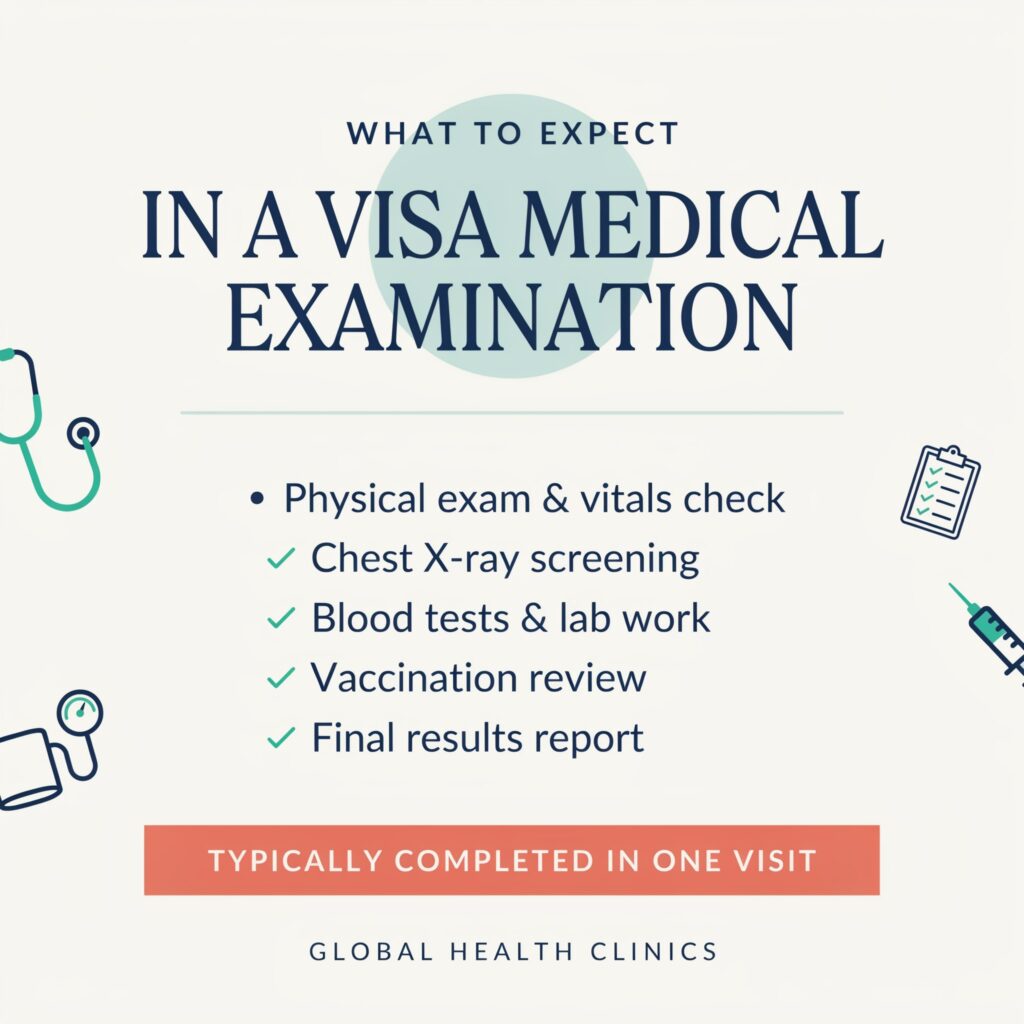
Plan for 60–90 minutes on-site, though vaccines or additional tests can extend your visit or require a return trip.
Administrative Intake and Forms
You’ll check in, present your passport and appointment letter, and complete a medical history questionnaire. Questions cover past surgeries, chronic illnesses, mental-health history, substance use, and any prior TB exposure. You’ll sign a consent form authorizing the examination and, where applicable, vaccination.
Physical Exam and Tests
A nurse or physician will:
- Measure vitals – height, weight, blood pressure, pulse, temperature.
- Perform a general physical – examine eyes, ears, nose, throat, heart, lungs, abdomen, skin, and extremities.
- Screen for tuberculosis – a TB test (PPD skin test or IGRA blood test like QuantiFERON). If positive or if you’re from a high-TB-burden country, you’ll get a chest X-ray.
- Draw blood – tests typically include a syphilis test (RPR/VDRL) and, in some posts, HIV screening (HIV is no longer a ground of inadmissibility, but testing may still occur for medical records).
- Urinalysis and pregnancy test – for females of childbearing age when clinically indicated.
- Stool sample – required in certain countries to screen for intestinal parasites.
- Vision and hearing screening – brief checks; bring your glasses.
Vaccinations and Follow-Up Shots
The physician reviews your vaccination record against the CDC’s Technical Instructions. Required vaccines commonly include:
- MMR (measles, mumps, rubella)
- Polio
- Varicella (chickenpox)
- Hepatitis B
- Tdap (tetanus, diphtheria, pertussis)
- Influenza (seasonal)
- COVID-19 (required for most immigrant visa applicants as of current CDC guidance)
If you’re missing doses, the clinic administers them on-site or schedules a follow-up. You’ll sign a consent for each vaccine. Mild side effects (soreness, low fever) are normal; serious reactions are rare.
Pediatric note: Children follow an age-appropriate schedule. A 3-year-old won’t need the same shots as a 30-year-old. Bring the child’s full immunization card.
Forms, Results, and How They’re Submitted
- Consular (panel physician): Results are placed in a sealed envelope you carry to your visa interview—do not open it. Some posts now transmit results electronically to the consulate. You may also receive a copy of Form DS-3025 (Vaccination Documentation) for your records.
- USCIS (civil surgeon): The doctor completes Form I-693, seals it in an envelope, and signs across the flap. You submit the sealed envelope with your I-485 package or bring it to your adjustment interview.
Timeline: Straightforward cases are ready in 3–7 business days. If you need TB treatment or multiple vaccine doses, results may take 4–12 weeks. Ask the clinic for a realistic pickup or mailing date before you leave.
Possible Outcomes and Next Steps
| Outcome | What It Means | Your Next Step |
|---|---|---|
| Cleared – no conditions | You meet all health requirements. | Attend your interview or file I-485. |
| Cleared after treatment/vaccination | A minor issue (e.g., one missing vaccine) was resolved on-site. | Keep your receipt; bring proof to interview. |
| Temporary delay | Active TB, untreated syphilis, or incomplete vaccine series. | Complete treatment, return for re-test, then receive clearance. |
| Inadmissibility finding | A communicable disease of public health significance or failure to vaccinate without a valid exemption. | Consult an immigration attorney. You may qualify for a waiver (Form I-601 or I-601A) or a CDC-approved vaccination waiver. |
Tip: If your result requires follow-up, notify your sponsor or attorney immediately so they can adjust interview timelines. Keep every receipt, lab report, and vaccination record in a dedicated folder.
Cost, Insurance, and Payment Tips
- Typical fees: $150–$500+ for the exam itself, depending on country and clinic. Vaccines, X-rays, and blood work may add $50–$300. In the U.S., civil-surgeon visits often range from $200–$600 before vaccines.
- Insurance: Most U.S. health-insurance plans do not cover immigration medical exams because they’re government-mandated screenings, not diagnostic care. Some plans partially cover vaccines—ask your insurer.
- Payment tips: Request an itemized receipt. If multiple family members are examined at the same clinic, ask about a family or group discount. Pay by card when possible for a paper trail.
Special Situations and FAQs
Children and Pediatric Schedules
Kids follow CDC age-based vaccine tables. Bring the original immunization booklet. If records are lost, the physician may perform titer blood tests to prove immunity instead of re-vaccinating.
Pregnant Applicants
Chest X-rays are deferred until after delivery unless a TB risk demands earlier imaging (with abdominal shielding). Inform the physician immediately.
Chronic Conditions or Disabilities
Conditions like diabetes, hypertension, or mobility impairments are not grounds for inadmissibility. Bring medication lists and specialist letters so the examining doctor can note stable management.
Immunocompromised Applicants
If you’re on immunosuppressive therapy, certain live vaccines (MMR, varicella) may be contraindicated. The physician can document a medical exemption on Form I-693.
Military and Refugee Applicants
Refugees processed overseas follow a separate CDC protocol that may include additional screenings. U.S. military-sponsored applicants should check with their installation’s immigration office for streamlined scheduling.
Printable Checklist Before Your Exam
- [ ] Passport + photocopy
- [ ] Interview letter / USCIS notice
- [ ] Vaccination records (translated if needed)
- [ ] Blank Form I-693 (civil surgeon visits)
- [ ] Medical history summary & medication list
- [ ] Eyeglasses / contacts
- [ ] Payment method + confirm accepted forms
- [ ] For minors: birth certificate, immunization card, guardian present
- [ ] Translator arranged (if needed)
- [ ] Clinic address, hours, and parking confirmed
Final Thoughts
A visa medical examination doesn’t have to be stressful. Book early, bring organized documents, and treat it like a routine checkup—because for most applicants, that’s exactly what it is. If results flag a follow-up, you have clear pathways: treatment, re-testing, or a waiver with legal guidance.
Your next steps: Visit the USCIS civil surgeon locator or the Department of State panel physician list today and lock in your appointment. Review the CDC Technical Instructions so there are no surprises.
Have questions about your specific case—K-1 timing, a missing vaccine record, or a TB scare? Drop them in the comments below, and check out our related guides: “How to Prepare for Your U.S. Visa Interview” and “Vaccination Records: How to Build and Translate Them.”
This article is for informational purposes only and does not constitute legal or medical advice. Requirements change; always verify current guidance on USCIS.gov, Travel.State.gov, and CDC.gov before your appointment.
FAQ
Q: How long does a visa medical exam take?
A: Usually 30–90 minutes for the physical and blood work. Vaccines, X-rays, or follow-up tests can extend the process over one or two additional visits.
Q: Do I need vaccinations for a U.S. visa?
A: Yes. Most immigrant visa and adjustment-of-status applicants must show proof of CDC-required vaccines (MMR, polio, varicella, Hep B, Tdap, influenza, COVID-19) or receive them at the exam.
Q: Can I get the medical exam done after my visa interview?
A: For consular immigrant visas, the exam must be completed before the interview. For USCIS adjustment of status, you typically see a civil surgeon before filing Form I-485 or as instructed in your case.
Q: What if the doctor finds a communicable disease?
A: The physician may require treatment and issue a conditional clearance. For certain findings, you may need a waiver (Form I-601/I-601A). Consult an immigration attorney promptly.
Q: How long is the medical clearance valid?
A: Validity varies by visa type and findings—generally 6 months for most consular exams. Check your specific embassy or USCIS guidance for current validity periods.